Tags
Language
Tags
November 2026
Su Mo Tu We Th Fr Sa
1 2 3 4 5 6 7
8 9 10 11 12 13 14
15 16 17 18 19 20 21
22 23 24 25 26 27 28
29 30 1 2 3 4 5
    Attention❗ To save your time, in order to download anything on this site, you must be registered 👉 HERE. If you do not have a registration yet, it is better to do it right away. ✌

    ( • )( • ) ( ͡⚆ ͜ʖ ͡⚆ ) (‿ˠ‿)
    SpicyMags.xyz

    Trending now in eBooks & eLearning


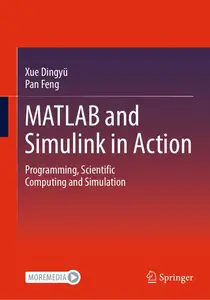
    MATLAB and Simulink in Action: Programming, Scientific Computing and Simulation (Repost)

    Posted By: AvaxGenius
    MATLAB and Simulink in Action: Programming, Scientific Computing and Simulation (Repost)

    MATLAB and Simulink in Action: Programming, Scientific Computing and Simulation by Dingyü Xue , Feng Pan
    English | PDF EPUB (True) | 2024 | 472 Pages | ISBN : 9819911753 | 125.9 MB

    The textbook is intended for teaching MATLAB language and its applications. The book is composed of three parts: MATLAB programming, scientific computing with MATLAB, and system simulation with Simulink. Since MATLAB is widely used in all fields of science and engineering, a good introduction to the language can not only help students learn how to use it to solve practical problems, but also provide them with the skills to use MATLAB independently in their later courses and research. The three parts of the book are well-balanced and tailored to the needs of engineering students, and the mathematical problems commonly encountered in engineering can be easily solved using MATLAB. This textbook is suitable for undergraduate and graduate students majoring in science and engineering.
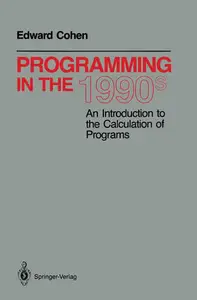
    Programming in the 1990s: An Introduction to the Calculation of Programs

    Posted By: AvaxGenius
    Programming in the 1990s: An Introduction to the Calculation of Programs

    Programming in the 1990s: An Introduction to the Calculation of Programs by Edward Cohen
    English | PDF | 1990 | 275 Pages | ISBN : 0387973826 | 16.3 MB

    Programming is a fascinating and challenging subject. Unfortunately, it is rarely presented as such. Most often it is taught by "induction": features of some famous programming languages are given operational meaning (e.g. a loop "goes round and round"), a number of examples are shown, and by induction, we are asked to develop other programs, often radically different from the ones we've seen. Basically we are taught to guess our programs, and then to patch up our guesses. Our errors are given the cute name of "bugs". Fixing them becomes puzzle-solving, as does finding tricks that exploit or avoid poorly designed features of the programming language. The entire process is time-consuming and expensive. And even so, we are never quite sure if our programs really work in all cases. When approached in this way, programming is indeed a dull activity. There is, however, another approach to programming, an approach in which programs can be developed reliably, with attention to the real issues. It is a practical approach based on methodically developing programs from their specifications. Besides being practical, it is exciting. Many programs can be developed with relative ease. Problems which once were difficult can now be solved by beginners. Elegant solutions bring great satisfaction. This is our subject. We are interested in making programming an exciting topic!

    Objects and Systems: Principled Design with Implementations in C++ and Java

    Posted By: AvaxGenius
    Objects and Systems: Principled Design with Implementations in C++ and Java

    Objects and Systems: Principled Design with Implementations in C++ and Java by Bernard P. Zeigler
    English | PDF | 1997 | 233 Pages | ISBN : 0387947817 | 15.9 MB

    The author's aim in this textbook is to provide students with a clear understanding of the relationship between the principles of object-oriented programming and software engineering. Professor Zeigler takes an approach based on state representation to formal specification. Consequently, this book is unique through its - emphasis on formulating primitives from which all other functionality can be built; - integral use of a semi-formal behaviour specification language based on state transition concepts; -differentiation between behaviour and implementation; -a reusable heterogeneous container class library; -ability to show the elegance and power of ensemble methods with non-trivial examples. As a result, students studying software engineering will find this a distinctive and valuable approach to programming and systems engineering.

    Categories for Software Engineering

    Posted By: AvaxGenius
    Categories for Software Engineering

    Categories for Software Engineering by José Luiz Fiadeiro
    English | PDF | 2005 | 254 Pages | ISBN : 3540209093 | 12.4 MB

    Why Another Book on Category Theory? In the past ten years, several books have been published on category t- ory either by computer scientists or having computer scientists as a target audience (e. g. [6, 12, 22, 89, 105], to which a precious collection of little gems [90] and the chapter cum book [91] should be added). Isn't the working computer scientist spoilt with choice? Although each of the above mentioned books presents an approach of its own, there is one aspect in common in their view of computer science: the analogy between arrows (morphisms) and (classes of) computations. This "type-theoretic" or "functional" approach corresponds to a view of c- puter science as a science of computation, i. e. a discipline concerned with the study of computational phenomena where the focus is on the nature and organisation of computations. However, there is another view of computer science where the focus is, instead, on the development of computer programs or systems. This is the approach that supports, for instance, software engineering. From this point of view, arrows do not capture computational phenomena, or abstractions thereof, but instead relationships between programs, or abstractions of programs, that arise in the development of computer systems, for instance, refinement of higher-level specifications into executable programs [100, 104], and superposition of new features over existing systems [72].

    Understanding Cryptography: A Textbook for Students and Practitioners

    Posted By: AvaxGenius
    Understanding Cryptography: A Textbook for Students and Practitioners

    Understanding Cryptography: A Textbook for Students and Practitioners by Christof Paar , Jan Pelzl
    English | PDF (True) | 2010 | 382 Pages | ISBN : 3642041019 | 2.6 MB

    Cryptography is now ubiquitous – moving beyond the traditional environments, such as government communications and banking systems, we see cryptographic techniques realized in Web browsers, e-mail programs, cell phones, manufacturing systems, embedded software, smart buildings, cars, and even medical implants. Today's designers need a comprehensive understanding of applied cryptography.

    Programming in Two Semesters: Using Python and Java (Repost)

    Posted By: AvaxGenius
    Programming in Two Semesters: Using Python and Java (Repost)

    Programming in Two Semesters: Using Python and Java by Quentin Charatan , Aaron Kans
    English | EPUB (True) | 2022 | 665 Pages | ISBN : 3031013255 | 152.1 MB

    This highly accessible textbook teaches programming from first principles. In common with many programming courses, it uses Python as the introductory programming language before going on to use Java as the vehicle for more advanced programming concepts.

    The Algorithm Design Manual

    Posted By: AvaxGenius
    The Algorithm Design Manual

    The Algorithm Design Manual by Steven S. Skiena
    English | PDF (True) | 2020 | 800 Pages | ISBN : 3030542580 | 9.9 MB

    "My absolute favorite for this kind of interview preparation is Steven Skiena’s The Algorithm Design Manual. More than any other book it helped me understand just how astonishingly commonplace … graph problems are – they should be part of every working programmer’s toolkit. The book also covers basic data structures and sorting algorithms, which is a nice bonus. … every 1 – pager has a simple picture, making it easy to remember. This is a great way to learn how to identify hundreds of problem types." (Steve Yegge, Get that Job at Google)

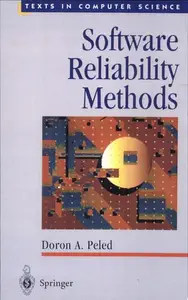
    Software Reliability Methods

    Posted By: AvaxGenius
    Software Reliability Methods

    Software Reliability Methods by Doron A. Peled
    English | PDF(True) | 2001 | 343 Pages | ISBN : 0387951067 | 30.6 MB

    Many books focus on increasing the quality of software through the use of formal methods. However, most books embrace one particular method, and present it as the suggested solution for the software reliability problem. This book presents a wider picture of formal methods, through a collection of notations and techniques. It compares them, and discusses their advantages and disadvantages. One of the main challenges of formal methods is in transferring the tech­ nology developed by researchers to the software development community. Re­ cently, we seem to be starting to have a better understanding of the important ingredients of formal methods tools. This manifests itself in the growing ac­ ceptance of such tools in the software and hardware development industry. Ideally, formal methods need to be intuitive to use (preferably using graphi­ cal interfaces), do not impose on the user an extensive learning period, and incur only small overhead to the development process. Formal methods are much more acceptable today than ten or twenty years ago, in particular in the hardware industry. Yet there is still a lively contention between different approaches.

    Fundamentals of Algebraic Graph Transformation

    Posted By: AvaxGenius
    Fundamentals of Algebraic Graph Transformation

    Fundamentals of Algebraic Graph Transformation by Hartmut Ehrig , Karsten Ehrig , Ulrike Prange , Gabriele Taentzer
    English | PDF (True) | 2006 | 383 Pages | ISBN : 3540311874 | 4.2 MB

    Graphs are widely used to represent structural information in the form of objects and connections between them. Graph transformation is the rule-based manipulation of graphs, an increasingly important concept in computer science and related fields. This is the first textbook treatment of the algebraic approach to graph transformation, based on algebraic structures and category theory.

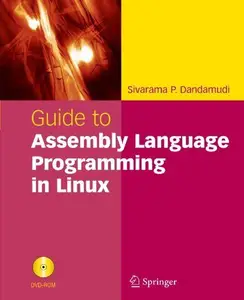
    Guide to Assembly Language Programming in Linux

    Posted By: AvaxGenius
    Guide to Assembly Language Programming in Linux

    Guide to Assembly Language Programming in Linux by Sivarama P. Dandamudi
    English | PDF | 2005 | 540 Pages | ISBN : 0387258973 | 60.1 MB

    Processor designs can be broadly divided into CISC (Complex Instruction Set Computers) and RISC (Reduced Instruction Set Computers). The dominant processor in the PC market, Pentium, belongs to the CISC category, and Linux is fast becoming the number one threat to Microsoft’s Windows in the server market. This unique guidebook provides comprehensive coverage of the key elements of Assembly language programming, specifically targeting professionals and students who would like to learn Assembly and intend or expect to move to the Linux operating system.

    Android Application Development for the Intel Platform

    Posted By: AvaxGenius
    Android Application Development for the Intel Platform

    Android Application Development for the Intel Platform by Ryan Cohen , Tao Wang
    English | EPUB (True) | 2014 | 520 Pages | ISBN : 1484201019 | 21.6 MB

    The number of Android devices running on Intel processors has increased since Intel and Google announced, in late 2011, that they would be working together to optimize future versions of Android for Intel Atom processors. Today, Intel processors can be found in Android smartphones and tablets made by some of the top manufacturers of Android devices, such as Samsung, Lenovo, and Asus.

    TouchDevelop: Programming on the Go

    Posted By: AvaxGenius
    TouchDevelop: Programming on the Go

    TouchDevelop: Programming on the Go by R. Nigel Horspool , Nikolai Tillmann
    English | PDF EPUB (True) | 2013 | 263 Pages | ISBN : 1430261366 | 14.7 MB

    "The book is great! It's clear and easy to read, with loads of examples that showed my students what to do."
    – Larry Snyder, Emeritus Professor, University of Washington, Department of Computer Science and Engineering

    Distributed Programming: Theory and Practice

    Posted By: AvaxGenius
    Distributed Programming: Theory and Practice

    Distributed Programming: Theory and Practice by A. Udaya Shankar
    English | PDF | 2013 | 388 Pages | ISBN : 1461448808 | 3.3 MB

    Distributed Programming: Theory and Practice presents a practical and rigorous method to develop distributed programs that correctly implement their specifications. The method also covers how to write specifications and how to use them. Numerous examples such as bounded buffers, distributed locks, message-passing services, and distributed termination detection illustrate the method. Larger examples include data transfer protocols, distributed shared memory, and TCP network sockets.

    Principles of Programming Languages (Repost)

    Posted By: AvaxGenius
    Principles of Programming Languages (Repost)

    Principles of Programming Languages by Gilles Dowek
    English | PDF (True) | 2009 | 167 Pages | ISBN : 1848820313 | 2.8 MB

    By introducing the principles of programming languages, using the Java language as a support, Gilles Dowek provides the necessary fundamentals of this language as a first objective.

    Multimedia Introduction to Programming Using Java

    Posted By: AvaxGenius
    Multimedia Introduction to Programming Using Java

    Multimedia Introduction to Programming Using Java by David Gries , Paul Gries
    English | PDF (True) | 2005 | 539 Pages | ISBN : 0387226818 | 3.2 MB

    Although vital to modern software development, Java and object-oriented programming can pose significant challenges to newcomers. This text, unique in both scope and approach and accompanied by interactive content that you may find on extras.springer.com, addresses that learning curve by providing a careful, classroom-tested presentation of Java – from the fundamentals of variables, types, and expressions to procedural concepts like loops and sophisticated object-oriented ideas.