



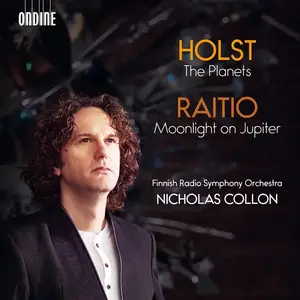
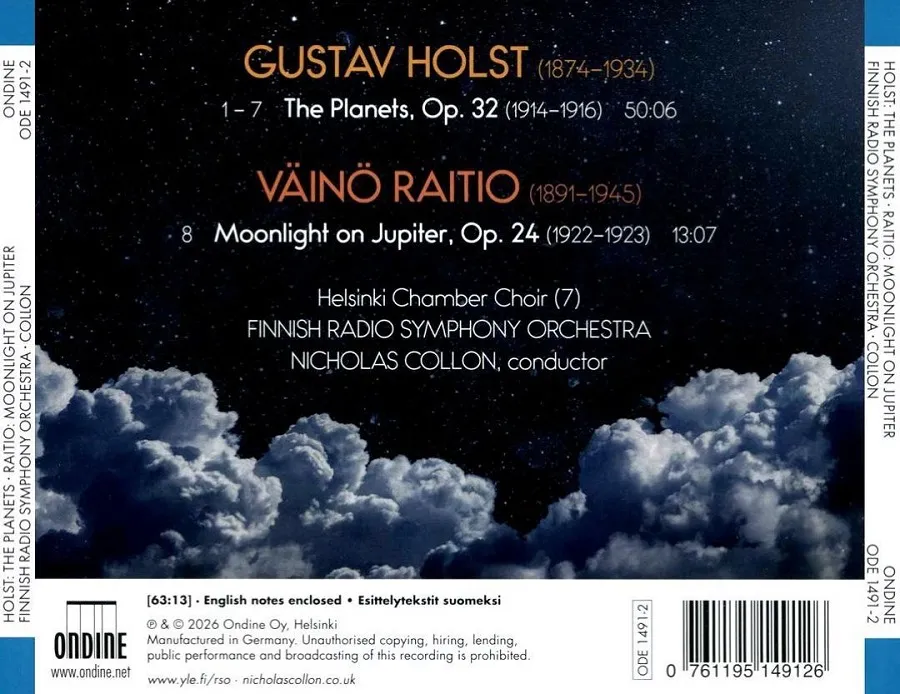
Nicholas Collon, Finnish Radio Symphony Orchestra - Holst: The Planets; Raitio: Moonlight on Jupiter (2026)
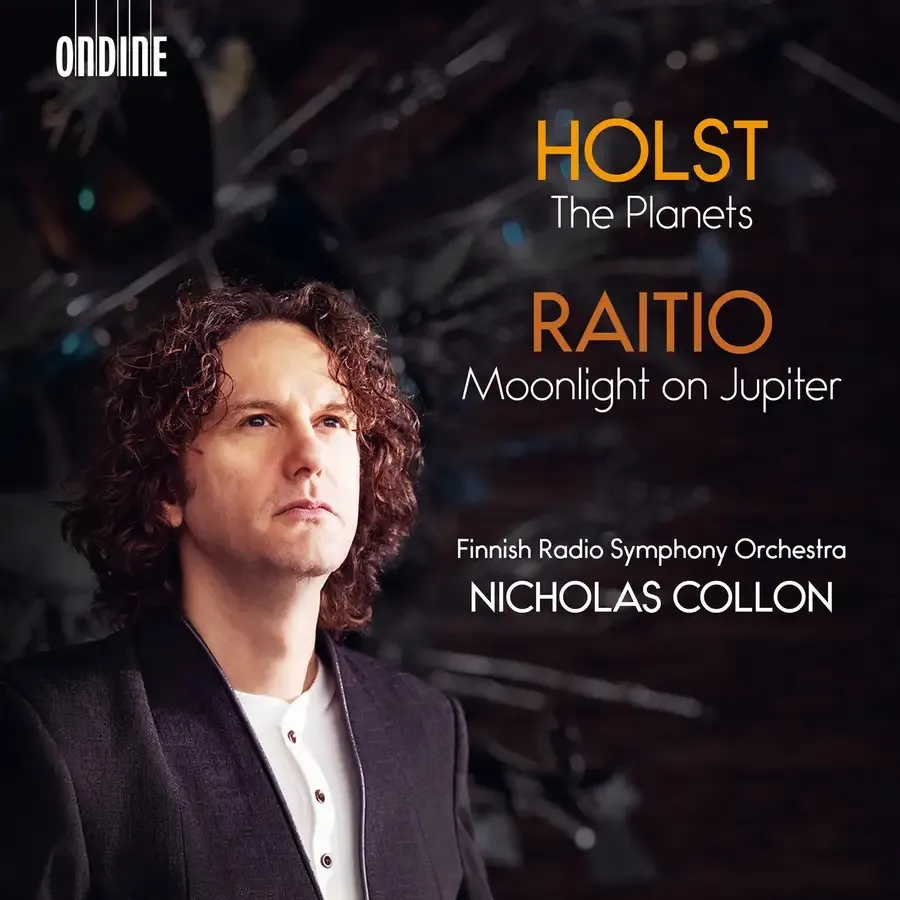
Nicholas Collon, Finnish Radio Symphony Orchestra - Holst: The Planets; Raitio: Moonlight on Jupiter (2026)
EAC | FLAC | Image (Cue & Log) ~ 274 Mb | Total time: 63:13 | Scans included
Classical | Label: Ondine | # ODE 1491-2 | Recorded: 2025
EAC | FLAC | Image (Cue & Log) ~ 274 Mb | Total time: 63:13 | Scans included
Classical | Label: Ondine | # ODE 1491-2 | Recorded: 2025
This album by the Finnish Radio Symphony Orchestra and Nicholas Collon joins together two impressive cosmic visions: Gustav Holst ’s iconic orchestral masterpiece The Planets together with a gem from Finnish orchestral literature, Väinö Raitio’s (1891–1945) Moonlight on Jupiter. Raitio’s work from the 1920s is recorded for the first time in 50 years and receives its first CD recording.
Aged forty, Holst began writing his best-known work, The Planets. This large-scale, seven-movement suite was completed it in 1916. Holst was concerned that his musical evocation of the planets should not be confused with characters from classical mythology, such as Venus. Neither is there any connection with astronomy. The basis of Holst’s inspiration was the much more controversial subject of astrology. Each movement of Holst’s ambitious suite reflects the alleged influence of a particular planet in our solar system upon human character. The Planets is written for a very large orchestra including much percussion, two harps, celesta, organ, two sets of timpani, and rarer instruments such as bass flute, bass oboe and tenor tuba. Holst’s own practical experience as an orchestral musician was invaluable to Holst in the development of his own boldly imaginative orchestration.
Väinö Raitio was one of the composers in what is known as the first wave of Modernism in Finnish music. Raitio’s idiom was very modern for his time, and this together with his premature death coloured his reputation among Finnish composers and musicologists. Raitio’s music of the 1920s is often described as having been influenced by the Colourist-Expressionist style of Alexander Scriabin and by French Impressionism. Raitio was above all an uncompromising visionary as a composer. What we know of Raitio as a person is vague, and he remains an enigmatic figure. Contemporary descriptions of him outline a shy and misanthropic recluse. He was no doubt an eccentric, at once reserved and uncompromising. The fantastic title of Moonlight on Jupiter was inspired by a compelling vision of space travel and of the multiple moons of Jupiter. It is also interesting that among all his works this was the one that he liked the best. The manuscript score bears a dedication: “This tone poem I dedicate to my cat, which came from Korso. I sent it to Jupiter in October 1922. V.R.” Raitio loved cats more than people and his dedication was a major upset to his contemporaries. In subsequent decades, Moonlight on Jupiter has come to be appreciated as perhaps the most satisfactory among all of Raitio’s 1920s orchestral work.
Performer:
Helsinki Chamber Choir (7)
Finnish Radio Symphony Orchestra
Nicholas Collon, conductor
Tracklist:
Gustav Holst (1874-1934)
The Planets, Op. 32 (1914–1916)
01. Mars, the Bringer of War. Allegro
02. Venus, the Bringer of Peace. Adagio
03. Mercury, the Winged Messenger. Vivace
04. Jupiter, the Bringer of Jollity. Allegro giocoso
05. Saturn, the Bringer of Old Age. Adagio
06. Uranus, the Magician. Allegro
07. Neptune, the Mystic. Andante – Allegretto
Väinö Raitio (1891-1945)
08. Moonlight on Jupiter, Op. 24 (1922–1923)
Exact Audio Copy V1.8 from 15. July 2024
EAC extraction logfile from 4. August 2026, 0:06
Finnish Radio Symphony Orchestra, Nicholas Collon / Holst - The Planets & Raitio - Moonlight on Jupiter
Used drive : HL-DT-STDVDRAM GP57EB40 Adapter: 1 ID: 0
Read mode : Secure
Utilize accurate stream : Yes
Defeat audio cache : Yes
Make use of C2 pointers : No
Read offset correction : 6
Overread into Lead-In and Lead-Out : No
Fill up missing offset samples with silence : Yes
Delete leading and trailing silent blocks : No
Null samples used in CRC calculations : Yes
Used interface : Native Win32 interface for Win NT & 2000
Used output format : User Defined Encoder
Selected bitrate : 1024 kBit/s
Quality : High
Add ID3 tag : No
Command line compressor : C:\Program Files (x86)\Exact Audio Copy\Flac\flac.exe
Additional command line options : -V -8 -T "Date=%year%" -T "Genre=%genre%" %source%
TOC of the extracted CD
Track | Start | Length | Start sector | End sector
––––––––––––––––––––––––––––-
1 | 0:00.00 | 7:33.31 | 0 | 34005
2 | 7:33.31 | 8:02.24 | 34006 | 70179
3 | 15:35.55 | 4:02.21 | 70180 | 88350
4 | 19:38.01 | 8:10.62 | 88351 | 125162
5 | 27:48.63 | 8:54.44 | 125163 | 165256
6 | 36:43.32 | 5:38.42 | 165257 | 190648
7 | 42:21.74 | 7:34.35 | 190649 | 224733
8 | 49:56.34 | 13:07.54 | 224734 | 283812
Range status and errors
Selected range
Filename C:\temp\Holst - The Planets; Raitio - Moonlight on Jupiter - 2026\Holst - The Planets & Raitio - Moonlight on Jupiter.wav
Peak level 92.0 %
Extraction speed 2.1 X
Range quality 99.9 %
Test CRC 9AC4B1FD
Copy CRC 9AC4B1FD
Copy OK
No errors occurred
AccurateRip summary
Track 1 not present in database
Track 2 not present in database
Track 3 not present in database
Track 4 not present in database
Track 5 not present in database
Track 6 not present in database
Track 7 not present in database
Track 8 not present in database
None of the tracks are present in the AccurateRip database
End of status report
–– CUETools DB Plugin V2.2.6
[CTDB TOCID: 445_94wTG89JhVnrVJRLa_alWFI-] found
Submit result: 445_94wTG89JhVnrVJRLa_alWFI- has been confirmed
Track | CTDB Status
1 | (2/2) Accurately ripped
2 | (2/2) Accurately ripped
3 | (2/2) Accurately ripped
4 | (2/2) Accurately ripped
5 | (2/2) Accurately ripped
6 | (2/2) Accurately ripped
7 | (2/2) Accurately ripped
8 | (2/2) Accurately ripped
==== Log checksum 7BF7E8B76A2FF388499B9B029F785033DB9D8056DFC187E609130ABEDC0941CD ====
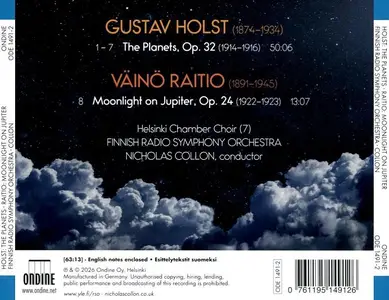
Nicholas Collon, Finnish Radio Symphony Orchestra - Holst: The Planets; Raitio: Moonlight on Jupiter (2026)
Thanks to the original releaser