Tags
Language
Tags
August 2026
Su Mo Tu We Th Fr Sa
26 27 28 29 30 31 1
2 3 4 5 6 7 8
9 10 11 12 13 14 15
16 17 18 19 20 21 22
23 24 25 26 27 28 29
30 31 1 2 3 4 5
    Attention❗ To save your time, in order to download anything on this site, you must be registered 👉 HERE. If you do not have a registration yet, it is better to do it right away. ✌

    ( • )( • ) ( ͡⚆ ͜ʖ ͡⚆ ) (‿ˠ‿)
    SpicyMags.xyz

    Trending now in Music


    The Counterpoints & friends - Italophilia: Discovering the Italian Style in Handel’s London (2024)

    Posted By: ArlegZ
    The Counterpoints & friends - Italophilia: Discovering the Italian Style in Handel’s London (2024)

    The Counterpoints & friends - Italophilia: Discovering the Italian Style in Handel’s London (2024)
    EAC | FLAC | Image (Cue & Log) ~ 391 Mb | Total time: 71:23 | Scans included
    Classical | Label: Challenge Records | # CC720003 | Recorded: 2024

    This CD by The Counterpoints, entitled Italophilia: Discovering the Italian style in Handel’s London, investigates the Italian musical influences on English baroque music in the seventeenth and eighteenth century. Already in 1683, Henry Purcell (1659-1695) had written in the foreword of his Sonatas of three Parts that he had ‘faithfully endeavour’d a just imitation of the most fam’d Italian Masters’. In later years, the impact of these Italian Masters would only increase, reaching its apogee in the work of George Frideric Handel (1685-1759). This CD contextualizes Handel’s work with composers he influenced and was influenced by, both in England and Italy.

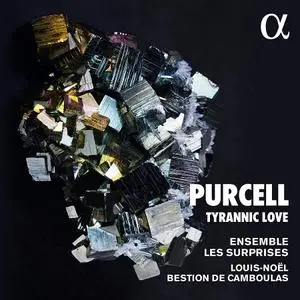
    Louis-Noël Bestion de Camboulas, Ensemble Les Surprises - Henry Purcell: Tyrannic Love (2020)

    Posted By: ArlegZ
    Louis-Noël Bestion de Camboulas, Ensemble Les Surprises - Henry Purcell: Tyrannic Love (2020)

    Louis-Noël Bestion de Camboulas, Ensemble Les Surprises - Henry Purcell: Tyrannic Love (2020)
    EAC | FLAC | Image (Cue & Log) ~ 302 Mb | Total time: 60:47 | Scans included
    Classical | Label: Alpha Classics | # ALPHA663 | Recorded: 2020

    Until the late 1680s, Henry Purcell composed almost exclusively for the royal court. But when the monarchy decided to reduce its expenditure on music in 1690, he joined the United Company, a London theatre company, and devoted himself to composing for its productions. These took varied forms, with operas such as King Arthur (1691), The Fairy Queen (1692) and The Indian Queen (1695) but also spoken plays with music, such as The Virtuous Wife (1695). It is excerpts from these works that are presented in Tyrannic Love. Compositions by Purcell’s colleagues or followers John Blow, John Eccles, Jeremiah Clarke and Daniel Purcell complete the programme.

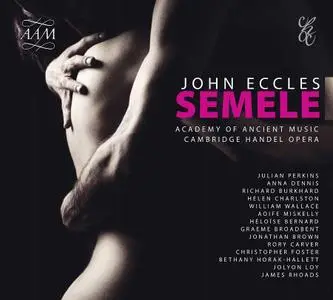
    Julian Perkins, Academy of Ancient Music - John Eccles: Semele (2021)

    Posted By: ArlegZ
    Julian Perkins,  Academy of Ancient Music - John Eccles: Semele (2021)

    Julian Perkins, Academy of Ancient Music - John Eccles: Semele (2021)
    EAC | FLAC | Image (Cue & Log) ~ 614 Mb | Total time: 72:04+49:20 | Scans included
    Classical | Label: AAM | # AAM 012 | Recorded: 2019

    Academy of Ancient Music, Cambridge Handel Opera Company, Cambridge Early Music and Julian Perkins are proud to present the first professional recording of John Eccless Semele (c.1707), a notable early setting of the great English libretto by William Congreve better known in a version by GF Handel from 1744. Academy of Ancient Musics mission is to explore, reveal and preserve the great treasure house of baroque and classical music, and a spirit of newfound discovery runs through all our work.

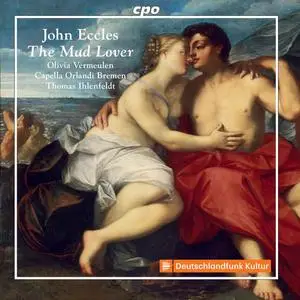
    Olivia Vermeulen, Thomas Ihlenfeldt, Capella Orlandi Bremen - John Eccles: The Mad Lover (2018)

    Posted By: ArlegZ
    Olivia Vermeulen, Thomas Ihlenfeldt, Capella Orlandi Bremen - John Eccles: The Mad Lover (2018)

    Olivia Vermeulen, Thomas Ihlenfeldt, Capella Orlandi Bremen - John Eccles: The Mad Lover (2018)
    EAC | FLAC | Image (Cue & Log) ~ 454 Mb | Total time: 66:13 | Scans included
    Classical | Label: CPO | # 555 061-2 | Recorded: 2016

    CPO's latest CD featuring the Capella Orlandi brings together stage music by Gottfried Finger and John Eccles, who wrote songs for the famous English stage actress Anne Bracegirdle. At the end of the seventeenth century England's theatrical world was shaped by the defensive stance of traditionalists toward influences from the Italian opera and the magnificence radiating from the French court. The English counterproposal, the 'English opera', was a combination of 'heroic plays' with musical inserts ranging from individual songs, as were performed during Shakespeare's time, to 'all-sung masques', miniature operas with pastoral content. The Mad Lover is a good example of the English opera. On this recording song inserts from other masques are added to this comedy by John Fletcher from 1647. Anne Bracegirdle was so very successful with compositions by John Eccles that she later exclusively sang works by him.
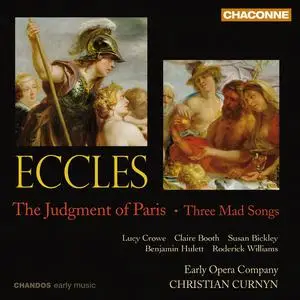
    Christian Curnyn, Early Opera Company - John Eccles: The Judgment of Paris, Three Mad Songs (2009)

    Posted By: ArlegZ
    Christian Curnyn, Early Opera Company - John Eccles: The Judgment of Paris, Three Mad Songs (2009)

    Christian Curnyn, Early Opera Company - John Eccles: The Judgment of Paris, Three Mad Songs (2009)
    EAC | FLAC | Image (Cue & Log) ~ 300 Mb | Total time: 62:14 | Scans included
    Classical | Label: Chandos | # CHAN 0759 | Recorded: 2008

    This "Paris" is special because it shows Eccles trying to shunt musical theater in an all-English direction, and move it out of the shadow of the dominant Italian and French traditions. As Lindsay Kemp points out in verbose but thorough liner notes, the word settings, or underlay is for English speech rhythms and the score focuses more on line and melody that decoration and ornamentation. This is a Maske, so it feels much more like music from a play than an opera. The score is a theatrical and musical treat, lived up to in this vibrant and energized performance, conducted by Christian Curnyn and sung by the Early Opera Company. The soloists are well cast, lucid and each of them really grasp the difference between this and opera. The Three Mad Songs that end the program are just that, set pieces from various English plays where the heroin loses it, usually because a man has done her wrong.