


Tags
Language
Tags
October 2026
Su Mo Tu We Th Fr Sa
27 28 29 30 1 2 3
4 5 6 7 8 9 10
11 12 13 14 15 16 17
18 19 20 21 22 23 24
25 26 27 28 29 30 31
    Attention❗ To save your time, in order to download anything on this site, you must be registered 👉 HERE. If you do not have a registration yet, it is better to do it right away. ✌

    ( • )( • ) ( ͡⚆ ͜ʖ ͡⚆ ) (‿ˠ‿)
    SpicyMags.xyz

    Trending now in eBooks & eLearning


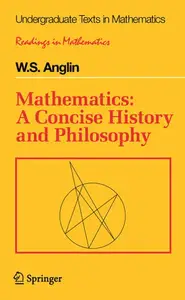
    Mathematics: A Concise History and Philosophy

    Posted By: AvaxGenius
    Mathematics: A Concise History and Philosophy

    Mathematics: A Concise History and Philosophy by W. S. Anglin
    English | PDF(True) | 1994 | 253 Pages | ISBN : 0387942807 | 15.5 MB

    This is a concise introductory textbook for a one-semester (40-class) course in the history and philosophy of mathematics. It is written for mathemat­ ics majors, philosophy students, history of science students, and (future) secondary school mathematics teachers. The only prerequisite is a solid command of precalculus mathematics. On the one hand, this book is designed to help mathematics majors ac­ quire a philosophical and cultural understanding of their subject by means of doing actual mathematical problems from different eras. On the other hand, it is designed to help philosophy, history, and education students come to a deeper understanding of the mathematical side of culture by means of writing short essays. The way I myself teach the material, stu­ dents are given a choice between mathematical assignments, and more his­ torical or philosophical assignments. (Some sample assignments and tests are found in an appendix to this book. ) This book differs from standard textbooks in several ways. First, it is shorter, and thus more accessible to students who have trouble coping with vast amounts of reading. Second, there are many detailed explanations of the important mathematical procedures actually used by famous mathe­ maticians, giving more mathematically talented students a greater oppor­ tunity to learn the history and philosophy by way of problem solving.
    Mathematical Analysis II (Repost)

    Posted By: AvaxGenius
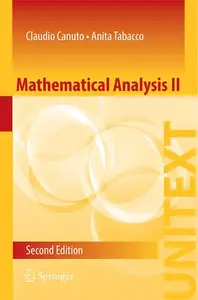
    Mathematical Analysis II (Repost)

    Mathematical Analysis II by Claudio Canuto , Anita Tabacco
    English | EPUB(True) | 2015 | 559 Pages | ISBN : 331912756X | 9.6 MB

    The purpose of the volume is to provide a support textbook for a second lecture course on Mathematical Analysis. The contents are organised to suit, in particular, students of Engineering, Computer Science and Physics, all areas in which mathematical tools play a crucial role. The basic notions and methods concerning integral and differential calculus for multivariable functions, series of functions and ordinary differential equations are presented in a manner that elicits critical reading and prompts a hands-on approach to concrete applications. The pedagogical layout echoes the one used in the companion text Mathematical Analysis I. The book’s structure has a specifically-designed modular nature, which allows for great flexibility in the preparation of a lecture course on Mathematical Analysis. The style privileges clarity in the exposition and a linear progression through the theory. The material is organised on two levels. The first, reflected in this book, allows students to graspthe essential ideas, familiarise with the corresponding key techniques and find the proofs of the main results. The second level enables the strongly motivated reader to explore further into the subject, by studying also the material contained in the appendices. Definitions are enriched by many examples, which illustrate the properties discussed. A host of solved exercises complete the text, at least half of which guide the reader to the solution. This new edition features additional material with the aim of matching the widest range of educational choices for a second course of Mathematical Analysis.

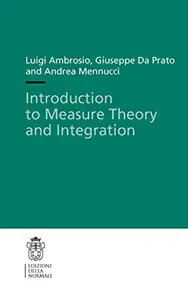
    Introduction to Measure Theory and Integration

    Posted By: AvaxGenius
    Introduction to Measure Theory and Integration

    Introduction to Measure Theory and Integration by Luigi Ambrosio , Giuseppe Prato , Andrea Mennucci
    English | PDF (True) | 2011 | 193 Pages | ISBN : 8876423850 | 1.4 MB

    This textbook collects the notes for an introductory course in measure theory and integration. The course was taught by the authors to undergraduate students of the Scuola Normale Superiore, in the years 2000-2011. The goal of the course was to present, in a quick but rigorous way, the modern point of view on measure theory and integration, putting Lebesgue's Euclidean space theory into a more general context and presenting the basic applications to Fourier series, calculus and real analysis. The text can also pave the way to more advanced courses in probability, stochastic processes or geometric measure theory. Prerequisites for the book are a basic knowledge of calculus in one and several variables, metric spaces and linear algebra. All results presented here, as well as their proofs, are classical. The authors claim some originality only in the presentation and in the choice of the exercises. Detailed solutions to the exercises are provided in the final part of the book.

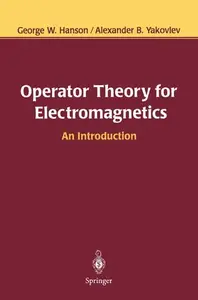
    Operator Theory for Electromagnetics: An Introduction

    Posted By: AvaxGenius
    Operator Theory for Electromagnetics: An Introduction

    Operator Theory for Electromagnetics: An Introduction by George W. Hanson , Alexander B. Yakovlev
    English | PDF | 2002 | 640 Pages | ISBN : 0387952780 | 44.3 MB

    The purpose of this book is to describe methods for solving problems in applied electromagnetic theory using basic concepts from functional anal­ ysis and the theory of operators. Although the book focuses on certain mathematical fundamentals, it is written from an applications perspective for engineers and applied scientists working in this area. Part I is intended to be a somewhat self-contained introduction to op­ erator theory and functional analysis, especially those elements necessary for application to problems in electromagnetics. The goal of Part I is to ex­ plain and synthesize these topics in a logical manner. Examples principally geared toward electromagnetics are provided. With the exception of Chapter 1, which serves as a review of basic electromagnetic theory, Part I presents definitions and theorems along with associated discussion and examples. This style was chosen because it allows one to readily identify the main concepts in a particular section. A proof is provided for all theorems whose proof is simple and straightforward. A proof is also provided for theorems that require a slightly more elaborate proof, yet one that is especially enlightening, being either constructive or illustrative. Generally. theorems are stated but not proved in cases where either the proof is too involved or the details of the proof would take one too far afield of the topic at hand, such as requiring additional lemmas that are not clearly useful in applications.

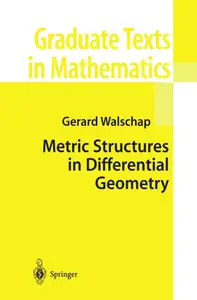
    Metric Structures in Differential Geometry

    Posted By: AvaxGenius
    Metric Structures in Differential Geometry

    Metric Structures in Differential Geometry by Gerard Walschap
    English | PDF (True) | 2004 | 235 Pages | ISBN : 038720430X | 20.2 MB

    This text is an elementary introduction to differential geometry. Although it was written for a graduate-level audience, the only requisite is a solid back­ ground in calculus, linear algebra, and basic point-set topology. The first chapter covers the fundamentals of differentiable manifolds that are the bread and butter of differential geometry. All the usual topics are cov­ ered, culminating in Stokes' theorem together with some applications. The stu­ dents' first contact with the subject can be overwhelming because of the wealth of abstract definitions involved, so examples have been stressed throughout. One concept, for instance, that students often find confusing is the definition of tangent vectors. They are first told that these are derivations on certain equiv­ alence classes of functions, but later that the tangent space of ffi.n is "the same" n as ffi. . We have tried to keep these spaces separate and to carefully explain how a vector space E is canonically isomorphic to its tangent space at a point. This subtle distinction becomes essential when later discussing the vertical bundle of a given vector bundle.

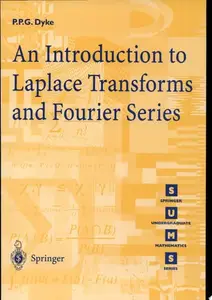
    An Introduction to Laplace Transforms and Fourier Series

    Posted By: AvaxGenius
    An Introduction to Laplace Transforms and Fourier Series

    An Introduction to Laplace Transforms and Fourier Series by Philip P. G. Dyke
    English | PDF (True) | 2001 | 257 Pages | ISBN : 1852330155 | 13.9 MB

    This book has been primarily written for the student of mathematics who is in the second year or the early part of the third year of an undergraduate course. It will also be very useful for students of engineering and the physical sciences for whom Laplace Transforms continue to be an extremely useful tool. The book demands no more than an elementary knowledge of calculus and linear algebra of the type found in many first year mathematics modules for applied subjects. For mathematics majors and specialists, it is not the mathematics that will be challenging but the applications to the real world. The author is in the privileged position of having spent ten or so years outside mathematics in an engineering environment where the Laplace Transform is used in anger to solve real problems, as well as spending rather more years within mathematics where accuracy and logic are of primary importance. This book is written unashamedly from the point of view of the applied mathematician. The Laplace Transform has a rather strange place in mathematics. There is no doubt that it is a topic worthy of study by applied mathematicians who have one eye on the wealth of applications; indeed it is often called Operational Calculus.

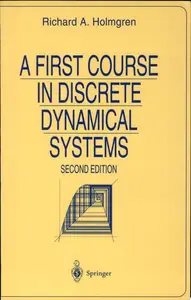
    A First Course in Discrete Dynamical Systems, Second Edition

    Posted By: AvaxGenius
    A First Course in Discrete Dynamical Systems, Second Edition

    A First Course in Discrete Dynamical Systems, Second Edition by Richard A. Holmgren
    English | PDF (True) | 1996 | 231 Pages | ISBN : 0387947809 | 16.8 MB

    Discrete dynamical systems are essentially iterated functions. Given the ease with which computers can do iteration, it is now possible for anyone with access to a personal computer to generate beautiful images whose roots lie in discrete dynamical systems. Images of Mandelbrot and Julia sets abound in publications both mathematical and not. The mathematics behind the pictures are beautiful in their own right and are the subject of this text. The level of the presentation is suitable for advanced undergraduates with a year of calculus behind them. Students in the author's courses using this material have come from numerous disciplines; many have been majors in other disciplines who are taking mathematics courses out of general interest. Concepts from calculus are reviewed as necessary. Mathematica programs that illustrate the dynamics and that will aid the student in doing the exercises are included in an appendix.

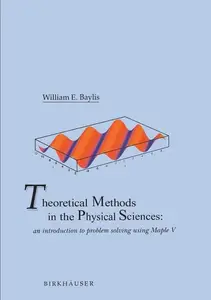
    Theoretical Methods in the Physical Sciences: An introduction to problem solving using Maple V

    Posted By: AvaxGenius
    Theoretical Methods in the Physical Sciences: An introduction to problem solving using Maple V

    Theoretical Methods in the Physical Sciences: An introduction to problem solving using Maple V by William E. Baylis
    English | PDF | 1994 | 296 Pages | ISBN : 081763715X | 21.6 MB

    The advent of relatively inexpensive but powerful computers is af­ fecting practically all aspects of our lives, but some of the greatest influence is being felt in the physical sciences. However, university curricula and teaching methods have responded somewhat cautiously, having only recently come to terms with the now omnipresent calcula­ tor. While many instructors at first feared that the widespread use of pocket calculators would lead to generations of students who could not multiply or perhaps even add, few now seriously lament the disappear­ ance of slide rules, logarithm tables, and the often error-bound tedium that such tools of the trade demand. Time that used to be spent on the use of logarithm tables and manual square-root extraction can be prof­ itably turned to earlier studies of calculus or computer programming. Now that the calculator has been accepted into the classroom, we face a computer-software revolution which promises to be considerably more profound. Modern textbooks in the physical sciences routinely assume their readers have access not only to calculators, but often to home or even mainframe computers as well, and the problems teachers discuss and assign students can be more complex and often more realistic than in the days of only pad and pencil computations. As less effort is spent on numerical computation, more can be devoted to conceptual under­ standing and to applications of the increasingly sophisticated mathe­ matical methods needed for a real appreciation of recent advances in the discipline.

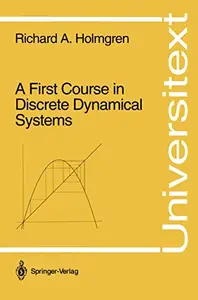
    A First Course in Discrete Dynamical Systems

    Posted By: AvaxGenius
    A First Course in Discrete Dynamical Systems

    A First Course in Discrete Dynamical Systems by Richard A. Holmgren
    English | PDF(True) | 1994 | 213 Pages | ISBN : 0387942084 | 20.8 MB

    An increasing number of colleges and universities are offering undergradu­ ate courses in discrete dynamical systems. This growth is due in part to the proliferation of inexpensive and powerful computers, which have provided access to the interesting and complex phenomena that are at the heart of dynamics. A second reason for introducing dynamics into the undergradu­ ate curriculum is that it serves as a bridge from concrete, often algorithmic calculus courses, to the more abstract concepts of analysis and topology. Discrete dynamical systems are essentially iterated functions, and if there is one thing computers do well, it is iteration. It is now possible for anyone with access to a personal computer to generate beautiful images whose roots lie in discrete dynamical systems. The mathematics behind the pictures are beautiful in their own right and are the subject of this text. Every effort has been made to exploit this opportunity to illustrate the beauty and power of mathematics in an interesting and engaging way. This work is first and foremost a mathematics book. Individuals who read it and do the exercises will gain not only an understanding of dynamical systems, but an increased understanding of the related areas in analysis as well.

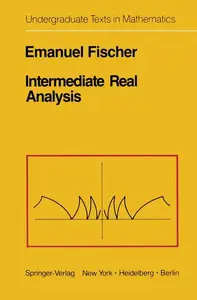
    Intermediate Real Analysis

    Posted By: AvaxGenius
    Intermediate Real Analysis

    Intermediate Real Analysis by Emanuel Fischer
    English | PDF | 1983 | 783 Pages | ISBN : 146139483X | 45.2 MB

    There are a great deal of books on introductory analysis in print today, many written by mathematicians of the first rank. The publication of another such book therefore warrants a defense. I have taught analysis for many years and have used a variety of texts during this time. These books were of excellent quality mathematically but did not satisfy the needs of the students I was teaching. They were written for mathematicians but not for those who were first aspiring to attain that status. The desire to fill this gap gave rise to the writing of this book. This book is intended to serve as a text for an introductory course in analysis. Its readers will most likely be mathematics, science, or engineering majors undertaking the last quarter of their undergraduate education. The aim of a first course in analysis is to provide the student with a sound foundation for analysis, to familiarize him with the kind of careful thinking used in advanced mathematics, and to provide him with tools for further work in it. The typical student we are dealing with has completed a three-semester calculus course and possibly an introductory course in differential equations. He may even have been exposed to a semester or two of modern algebra. All this time his training has most likely been intuitive with heuristics taking the place of proof. This may have been appropriate for that stage of his development.

    Ramsey Methods in Analysis

    Posted By: AvaxGenius
    Ramsey Methods in Analysis

    Ramsey Methods in Analysis by Spiros A. Argyros , Stevo Todorcevic
    English | PDF (True) | 2005 | 258 Pages | ISBN : 3764372648 | 2.4 MB

    This book contains two sets of notes prepared for the Advanced Course on R- sey Methods in Analysis given at the Centre de Recerca Matem` atica in January 2004, as part of its year-long research programme on Set Theory and its Appli- tions. The common goal of the two sets of notes is to help young mathematicians enter a very active area of research lying on the borderline between analysis and combinatorics. The solution of the distortion problem for the Hilbert space, the unconditional basic sequence problem for Banach spaces, and the Banach ho- geneous space problem are samples of the most important recent advances in this area, and our two sets of notes will give some account of this. But our main goal was to try to expose the general principles and methods that lie hidden behind and are most likely useful for further developments. The goal of the ?rst set of notes is to describe a general method of building norms with desired properties, a method that is clearly relevant when testing any sort of intuition about the in?nite-dimensional geometry of Banach spaces. The goal of the second set of notes is to expose Ramsey-theoretic methods relevant for describing the rough structure present in this sort of geometry. We would like to thank the coordinator of the Advanced Course, Joan Ba- ria, and the director of the CRM, Manuel Castellet, for giving us this challenging but rewarding opportunity. Part A SaturatedandConditional StructuresinBanachSpaces SpirosA.

    Numerical Bayesian Methods Applied to Signal Processing

    Posted By: AvaxGenius
    Numerical Bayesian Methods Applied to Signal Processing

    Numerical Bayesian Methods Applied to Signal Processing by Joseph J. K. Ó Ruanaidh , William J. Fitzgerald
    English | PDF (True) | 1996 | 256 Pages | ISBN : 0387946292 | 35.8 MB

    This book is concerned with the processing of signals that have been sam­ pled and digitized. The fundamental theory behind Digital Signal Process­ ing has been in existence for decades and has extensive applications to the fields of speech and data communications, biomedical engineering, acous­ tics, sonar, radar, seismology, oil exploration, instrumentation and audio signal processing to name but a few [87]. The term "Digital Signal Processing", in its broadest sense, could apply to any operation carried out on a finite set of measurements for whatever purpose. A book on signal processing would usually contain detailed de­ scriptions of the standard mathematical machinery often used to describe signals. It would also motivate an approach to real world problems based on concepts and results developed in linear systems theory, that make use of some rather interesting properties of the time and frequency domain representations of signals. While this book assumes some familiarity with traditional methods the emphasis is altogether quite different. The aim is to describe general methods for carrying out optimal signal processing.

    Applied Multivariate Data Analysis: Regression and Experimental Design

    Posted By: AvaxGenius
    Applied Multivariate Data Analysis: Regression and Experimental Design

    Applied Multivariate Data Analysis: Regression and Experimental Design by J. D. Jobson
    English | PDF | 1991 | 646 Pages | ISBN : 0387976604 | 43.9 MB

    An easy to read survey of data analysis, linear regression models and analysis of variance. The extensive development of the linear model includes the use of the linear model approach to analysis of variance provides a strong link to statistical software packages, and is complemented by a thorough overview of theory. It is assumed that the reader has the background equivalent to an introductory book in statistical inference. Can be read easily by those who have had brief exposure to calculus and linear algebra. Intended for first year graduate students in business, social and the biological sciences. Provides the student with the necessary statistics background for a course in research methodology. In addition, undergraduate statistics majors will find this text useful as a survey of linear models and their applications.

    Dynamics of Data Envelopment Analysis: Theory of Systems Efficiency

    Posted By: AvaxGenius
    Dynamics of Data Envelopment Analysis: Theory of Systems Efficiency

    Dynamics of Data Envelopment Analysis: Theory of Systems Efficiency by Jati K. Sengupta
    English | PDF | 1995 | 296 Pages | ISBN : 0792335813 | 20.3 MB

    Data envelopment analysis develops a set of nonparametric and semiparametric techniques for measuring economic efficiency among firms and nonprofit organizations. Over the past decade this technique has found most widespread applications in public sector organizations. However these applications have been mostly static. This monograph extends this static framework of efficiency analysis in several new directions. These include but are not limited to the following: (1) a dynamic view of the production and cost frontier, where capital inputs are treated differently from the current inputs, (2) a direct role of the technological progress and regress, which is so often stressed in total factor productivity discussion in modem growth theory in economics, (3) stochastic efficiency in a dynamic setting, where reliability improvement competes with technical efficiency, (4) flexible manufacturing systems, where flexibility of the production process and the economies of scope play an important role in efficiency analysis and (5) the role of economic factors such as externalities and input interdependences. Efficiency is viewed here in the framework of a general systems theory model. Such a view is intended to broaden the scope of applications of this promising new technique of data envelopment analysis. The monograph stresses the various applied aspects of the dynamic theory, so that it can be empirically implemented in different situations. As far as possible abstract mathematical treatments are avoided and emphasis placed on the statistical examples and empirical illustrations.

    Elementary Number Theory

    Posted By: AvaxGenius
    Elementary Number Theory

    Elementary Number Theory by Gareth A. Jones , J. Mary Jones
    English | PDF (True) | 1998 | 305 Pages | ISBN : 3540761977 | 19.7 MB

    Our intention in writing this book is to give an elementary introduction to number theory which does not demand a great deal of mathematical back­ ground or maturity from the reader, and which can be read and understood with no extra assistance. Our first three chapters are based almost entirely on A-level mathematics, while the next five require little else beyond some el­ ementary group theory. It is only in the last three chapters, where we treat more advanced topics, including recent developments, that we require greater mathematical background; here we use some basic ideas which students would expect to meet in the first year or so of a typical undergraduate course in math­ ematics. Throughout the book, we have attempted to explain our arguments as fully and as clearly as possible, with plenty of worked examples and with outline solutions for all the exercises. There are several good reasons for choosing number theory as a subject. It has a long and interesting history, ranging from the earliest recorded times to the present day (see Chapter 11, for instance, on Fermat's Last Theorem), and its problems have attracted many of the greatest mathematicians; consequently the study of number theory is an excellent introduction to the development and achievements of mathematics (and, indeed, some of its failures). In particular, the explicit nature of many of its problems, concerning basic properties of inte­ gers, makes number theory a particularly suitable subject in which to present modern mathematics in elementary terms.